One Decision at a Time Blog
Weekly inspiration to help you build the career you want
and earn the salary you deserve.

How Do You Talk To Yourself?
In this third article on imposter syndrome, I’ll address one of the biggest challenges for most people, especially women, and that’s how you talk to yourself. I’m talking about negative self-talk, but it’s so much more than that. What is negative self-talk? Simply put, it’s the voice in your head—the inner critic—that constantly talks you out of taking chances and doing those things you want to do.
It’s that inner critic that says things like:
· “I can’t apply for that job. I’ll never get it. I’m not smart enough.”
· “I should never have volunteered to take on that project. I’ll never do it good enough.”
· “I’m the same age as she is, and she’s a Vice President, and I’m just a manager. She’s so much smarter than me.” (Because we LOVE to compare ourselves to others!)
· “Why did I say that in the meeting? Now everyone thinks I’m an idiot.”
· “Why didn’t I say anything in that meeting? Now everyone thinks I’m an idiot” (and I hope you saw in those last two that there’s just no way to win against the inner critic. 🤷🏻♀️
Do any of these sound like YOUR inner critic? I’ve even uttered a few of these in the past. Heck – every week I send out an email, I think, “Why am I doing this? No one wants to read what I have to say.”.
But when you think about it, that inner critic says things we would NEVER say to a loved one. Honestly, would you EVER tell your BFF, “You look like a cow in that dress!”. Nope, but we say things like that to ourselves all the time. WHY?
Why do you have an inner critic?
Here’s the deal. We ALL have an inner critic, and it’s not our fault. As human beings, we are hard-wired for protection. Over millions of years, our brains developed a safety mechanism to protect us from predators. And when saber-toothed tigers were roaming the prairies, that was welcomed. But NOW, that part of our brain is trying to protect us from saying the wrong thing in an email. Not quite the same level, is it?
How does negative self-talk impact you?
We’ve all experienced the stress of negative self-talk, that nagging doubt, and anxiety.
But that doubt and anxiety lead to stress-related issues such as lack of sleep, physical illness, mental health issues, and in some cases, pure burnout. We say things like, “I just can’t do this.”
That then starts to impact you financially. By thinking we’re not good enough, we pass up projects that give us more organizational visibility. We don’t apply for jobs we’d be amazing at because we don’t think we have all the skills. We say things like, “I’d love that job, but I’m just not smart enough.”
You start to limit your thinking. The more you tell yourself you can't do something, the more you believe it. You begin to believe yourself when you say, “I’m just no good at anything with numbers or technology or whatever you fill in this blank with.” I remember for the longest time saying, “I’m no good with anything technology related.”. Then, I had a VP who asked me to manage a tech support team. Not only did I find out I COULD do it, I realized I liked it.
Your perfectionism kicks in. You begin to believe that "great" isn't as good as "perfect" and that perfection is attainable. You say, “I know this isn’t good enough. I made a mistake, and it wasn’t perfect.” You do something repeatedly until they’re perfect and either miss deadlines or beat yourself up because you “just know” it could have been better.
All of this leads to feelings of depression. Research has shown that negative self-talk can exacerbate feelings of depression and, if left unchecked, could be pretty damaging. You start to believe you’re not good enough and don’t want to be with others.
Negative self-talk can cause relationship challenges too. Whether the constant self-criticism makes you seem insecure or you turn your negative self-talk into more general negative habits that bother others, a lack of communication and even a "playful" amount of criticism can take a toll.
How do I stop my inner critic?
You don’t! Your inner critic is here to stay, so what you want to do is to make friends with her. Your inner critic really wants to help you. She doesn’t know how. She’ll tell you stories about what you can and can’t do, and you believe her. But her stories aren’t factual. And THAT is how you learn to turn your inner critic into your inner coach; learn to discern fact from fiction. And here’s how!
Follow the STOP model

This is very literal. You stop what you’re doing. Put things down a minute and recognize that you are participating in negative self-talk. How do you do this?
First, you need to recognize your triggers; the only way to do that is to consciously capture when you find yourself engaging in negative self-talk. Make sure to use a self-talk journal to capture the event that triggered the negative self-talk and what happened. You can download a copy here.

The next step is to take a breath. This is SO important. When we’re upset, we tend to react to things. This is the fight or flight response in action. That’s why you stopped, and now you’re going to take a breath. I love box breathing. It’s a deep breathing technique that can help you slow down your breathing and help to calm your nervous system. You take a breath in for a count of four, hold it for a count of four, release it to a count of four, and then count to 4 before taking the next breath.

You can start conversing with your inner critic with the observation step. Here’s where you’ll observe what’s happening. This is where you begin to discern those facts from fiction with these questions.
• What’s the story I’m telling myself?
• Is this my opinion, or is it a fact?
• What evidence do I have?
• How can I see this differently?
• What advice would I give to a friend in this situation?
• What kind words can I say to myself?

Finally, now that you’ve taken the time to reflect on what’s happened, you can plan a different approach to the situation. What might you say differently to yourself? How could you reverse your previous negative self-talk? Here are some examples:
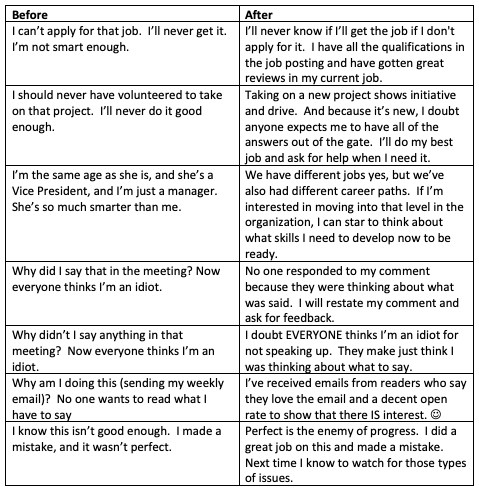
Next time you hear negative self-talk in your own dialogue, remember to Stop, Take a Breath, Observe what’s going on, and Plan another approach. You may just find your inner critic IS trying to help you. Want to learn more? Check out Four Reasons to Make Friends With YOUR Inner Critic here.